Market Sentiment: “Just one disappointment?”

Unlike major foreign indices, the DAX remains just below its record high, prompting many to take short positions. Joachim Goldberg knows what this means for the coming days.
Summary
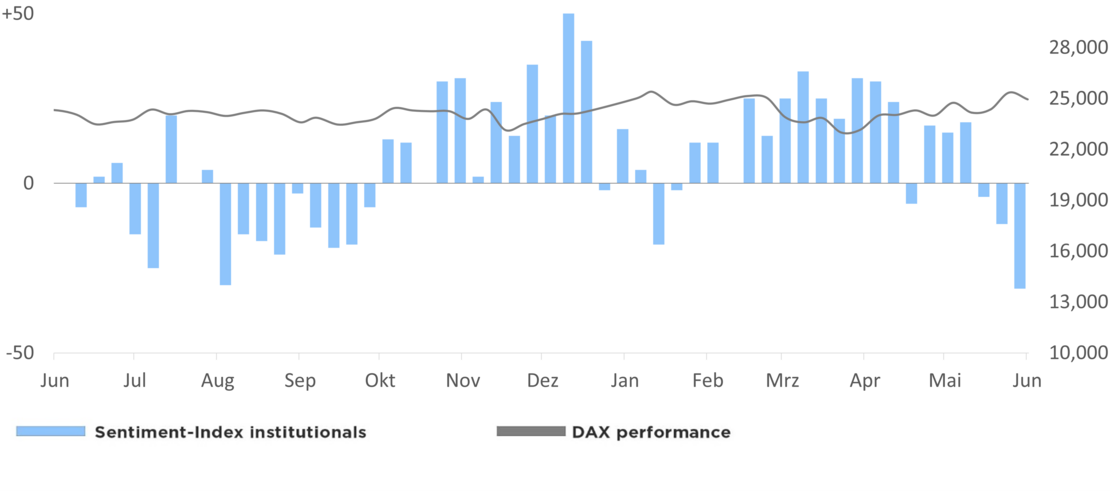
In response to the narrow trading range and slight overall decline, medium-term investors—especially professionals—are primarily opening new short positions. In addition, 8 percent are selling off German blue chips. The sentiment index for this group has fallen to -31 points. Retail investors are moving in a similar direction, though to a much lesser extent.
For Joachim Goldberg, there is strong evidence that the newly arrived pessimists are focusing on the previous record high, which has not yet been surpassed. On balance, he sees potential demand on the downside starting at 24,550/24,600 DAX points. Things would get interesting if the DAX were to rise toward the record high anyway, as a short squeeze would be looming there.
June 3, 2026. FRANKFURT (Goldberg & Goldberg). “One disappointment after another” – that’s the headline a stock market expert chose for his latest commentary. He may well have been thinking of how the past week of market sentiment unfolded. While the S&P 500 and the Nasdaq climbed to new records in the U.S., the same could hardly be said of the DAX. Yet all it would have taken for the DAX to reach previously unseen heights was a small jump of less than 100 points. Instead, even for those accustomed to recent volatility, there was little to get excited about: at just 2 percent, the trading range was less than half that of the previous week. The confusing news situation regarding a possible peace plan for the Iran conflict likely also contributed to the DAX’s performance at least not continuing its upward trend. However, the truth is also that pessimists have not really gotten their money’s worth so far—the first demand level we’ve identified (see below) has not yet been tested.
And yes, the number of pessimists among the institutional investors with a medium-term trading horizon whom we surveyed has increased once again: For the third time in a row, our Deutsche Börse Sentiment Index has fallen, most recently by 19 points to a new low of -31. This is the lowest level since early 2024. Meanwhile, the bear camp has grown by 12 percentage points. Nearly 60 percent of this increase is attributable to former optimists who may have done a complete 180 on their positions during the recent upward move. But a significant number of previously neutral players have also joined the bears. Overall, the Deutsche Börse Sentiment Index has fallen by 49 points over the past three weeks!
Active retail investors are following suit
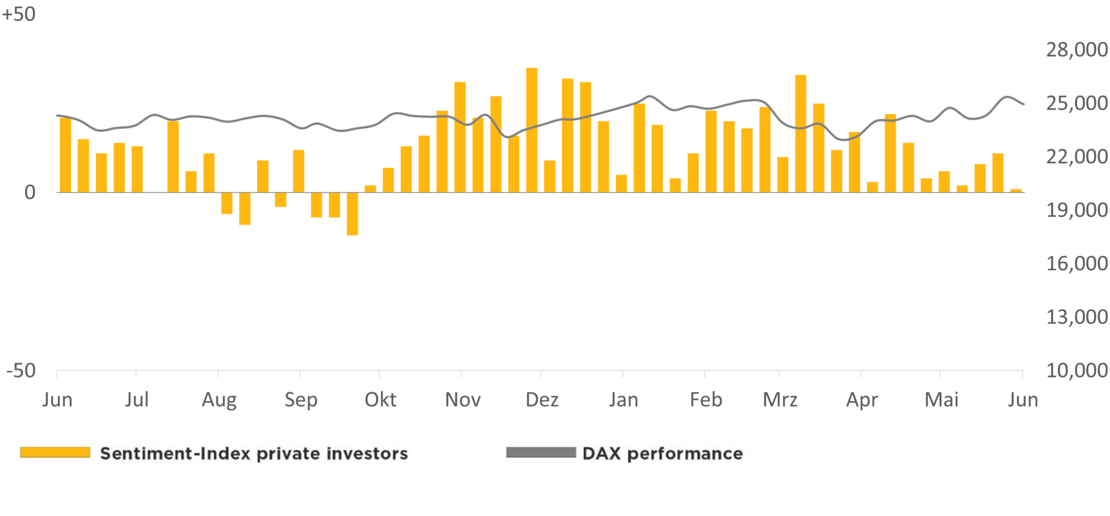
Sentiment has also deteriorated among retail investors. Here, our sentiment index has fallen by 10 points to a new level of +1. The decline in this group is primarily attributable to those retail investors whom we do not survey via social media. In this subgroup, the number of bulls has decreased by 8 percentage points, with nearly all of the former optimists shifting toward the sidelines to join the neutral investors. A similar trend is evident among those surveyed via social media, but it is striking just how large the discrepancy has become compared to the retail investors we do not survey via social media. Although the sentiment index in this subgroup is not falling as sharply as among its institutional counterparts, it has nevertheless dropped by 9 points to a new level of -12.
At the same time, the gap in sentiment between retail and institutional investors has widened once again. Incidentally, the relative sentiment analysis over three and six months shows just how poor the sentiment among the latter actually is. In this area, we are seeing index levels as low as those last seen in April 2020—that is, in the midst of the COVID-19 crisis—when, after the market had overcome its lows, the majority of market participants were unwilling to believe in a sustained DAX recovery.
“Smart” Selling Ahead of Key Reference Point
Of course, the situation is different this time. There is much to suggest that even the newly arrived pessimists—driven in part by skepticism that a quick agreement between the U.S. and Iran is unlikely—are likely basing their positions on the previous reference point of “record high,” which has not yet been surpassed. This means that the DAX’s 1.6 percent decline (point-to-point comparison) since last Wednesday is likely mostly self-inflicted. At the same time, demand on the downside has strengthened at a lower level, for the first time in the range of 24,550–24,600 DAX points. However, things will get interesting if the DAX does end up climbing to new record levels, because the risk of a short squeeze has now materialized. This is especially true if the DAX does not fall back to the aforementioned level beforehand, which would likely prevent the numerous pessimists from mentally buying back their positions.
by Joachim Goldberg
June 3, 2026, © Goldberg & Goldberg for Deutsche Börse
Sentiment-Analyse als Podcast
Sie können sich die Sentiment-Analyse direkt über diese Seite anhören oder herunterladen. Es gibt sie natürlich auch auf den üblichen Podcast-Plattformen Spotify, iTunes, Podcaster, Amazon, Google, auf denen Sie ihn abonnieren können.
Institutional Investor Sentiment Index
| Bullish | Bearish | Neutral | |
|---|---|---|---|
| Total | 23% | 54% | 23% |
| vs. last survey | -7% | +12% | -5% |
DAX (change from previous survey): 24.950 points (-400 points from the last survey)
Deutsche Börse Sentiment Index for Institutional Investors: -31 points (-19 points from the last survey)
Retail Investor Sentiment Index
| Bullish | Bearish | Neutral | |
|---|---|---|---|
| Total | 38% | 37% | 26% |
| vs. last survey | -8% | +2% | +6% |
DAX (change from previous survey): 24.950 points (-400 points from the last survey)
Deutsche Börse Sentiment Index for Retail Investors: +1 points (-10 points from the last survey)
About the Deutsche Börse Sentiment Index
The Deutsche Börse Sentiment Index ranges from -100 (total pessimism) to +100 (total optimism); the transition from positive to negative values marks the neutral line.

More articles from this columnist
| Time | Title |
|---|
 Deutsche Börse