Market Sentiment: “Sobering Reality After Brief Euphoria”

Hopes for renewed momentum on the German stock market have been dashed for the time being: the previously clear division among institutional investors has all but disappeared. According to Joachim Goldberg, without stronger international interest, the DAX continues to lack sustainable upward trends.
Summary
Zwar scheint die Stimmung gegenüber der Vorwoche vordergründig kaum verändert, aber hinter den Kulissen hat sich eine Menge getan. Dies gilt vor allen Dingen für die institutionellen Investoren, unter denen eine selten deutliche Polarisierung zwischen Bullen und Bären entstanden ist. Erstere Gruppe hat sich um 6 Prozentpunkte vergrößert, während die Gruppe der Pessimisten gar um 8 Prozentpunkte gewachsen ist. Eine etwas seltsam anmutende Konstellation, findet Joachim Goldberg, zumal der DAX heute früh aus seiner vorherrschenden Handelsrange nach oben ausgebrochen ist. Obwohl die Optimisten nun 50 Prozent aller Befragten ausmachen, stellen sie laut Goldberg kein allzu starkes Hindernis an der Oberseite dar.
May 13, 2026. FRANKFURT (Goldberg & Goldberg). There were likely quite a few market participants last week who were skeptical about the DAX breaking through the 25,000 mark. Meanwhile, the new optimism attributed to this jump—that the situation in the Iran conflict might actually take a turn for the better—has long since fizzled out. This has, of course, also been reflected in the DAX’s performance, as the market barometer took another downward plunge last Friday. When viewed on a chart, the price swings from last Wednesday and Thursday look like an island cut off from the rest of the action. Instead of an attempt to possibly test the DAX’s record high—which is no longer too far off—there was a “return to business as usual” after the DAX had previously lost nearly 5 percent in value from its peak since our last sentiment survey.
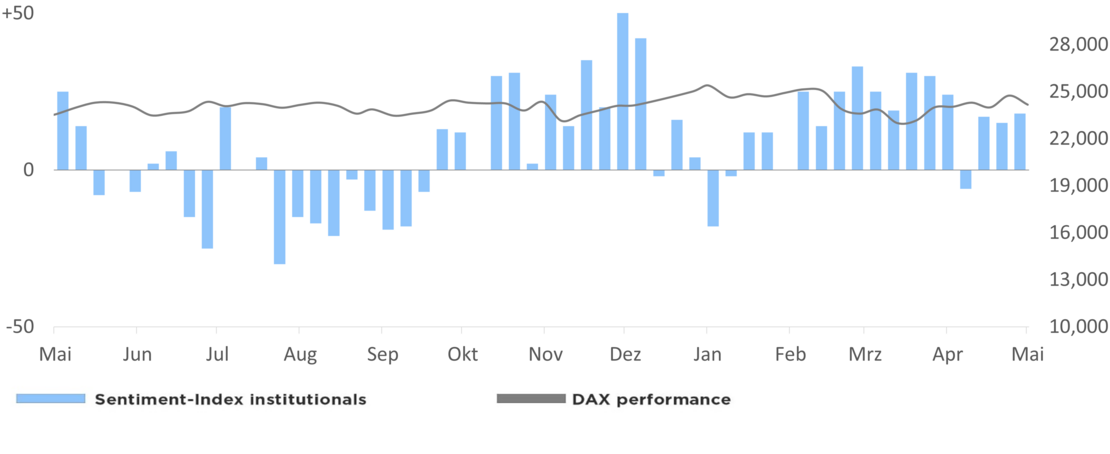
At first glance, the sentiment among the institutional investors we surveyed—who have a medium-term trading horizon—hasn’t changed much again. Our Deutsche Börse Sentiment Index has risen by just 3 points to a new level of +18.
Pulling Back to the Sidelines
Upon closer inspection, however, it becomes clear that the strong polarization between bulls and bears from the previous week has almost entirely subsided. The group of optimists has fallen by 4 percentage points, after having risen by 6 percentage points a week ago—the bear camp, which had grown by 8 percentage points just last Wednesday, has nearly completely shrunk. Consequently, we are seeing an 11-percentage-point increase among those who now expect the DAX to remain unchanged. The decline in polarization is likely due, at least in part, to profit-taking by both bulls and bears; on balance, however, this shift indicates a certain degree of disillusionment among market participants.
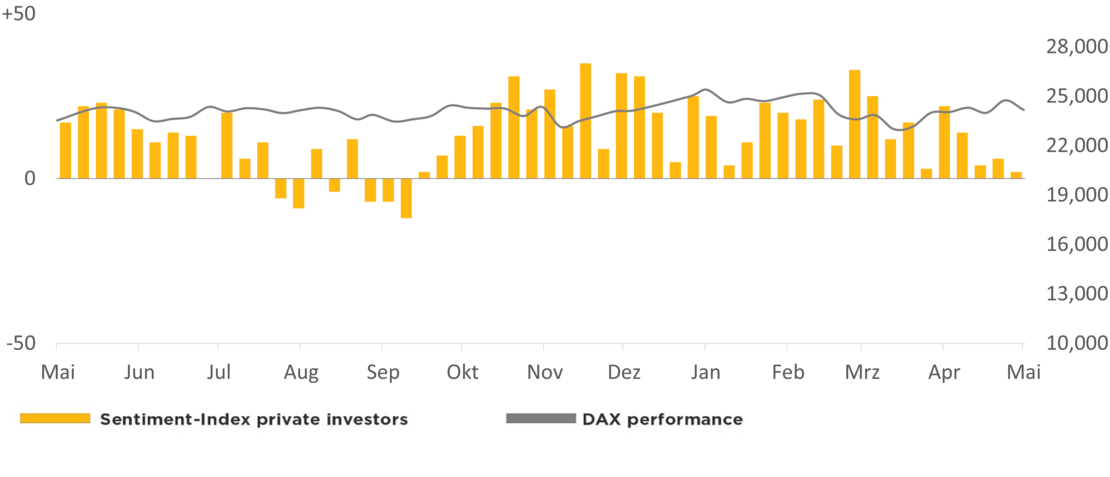
Among retail investors, the Deutsche Börse Sentiment Index fell by 4 points from the previous week to a new level of +2. This was driven by profit-taking on bullish positions—though, on balance, investors in this panel did not venture into short positions. However, if we exclude those investors whom we did not survey via social media, it becomes clear that at least some of the previously bullish investors have been driven to the short side. Though to a manageable extent. The sentiment index in this subgroup therefore falls by 6 points to a new level of -9. By contrast, retail investors surveyed via social media are naturally much more bullish than the other panel participants.
Ultimately, the gap in sentiment between retail and institutional investors widened slightly compared to the previous week. Among institutional investors, a bullish majority of 46 percent of all respondents remains, which is likely to weigh somewhat on the DAX. However, the absolute index level of +18 does not really appear threatening, especially since, from the more relevant relative perspective over three and six months, it effectively reduces to a neutral level. Among retail investors, when viewed this way, we must even speak of relative pessimism among those we do not survey via social media and among whom we frequently observe behavior similar to that of institutional investors.
Overall, however, this new positioning doesn’t really help the DAX. On the upside, there is a noticeable drag from potential profit-taking by optimists, while the downside is not sufficiently protected. As mentioned last week, the DAX is dependent on long-term capital inflows—preferably from abroad—for a sustained rise. However, it remains questionable whether international investors will actually favor European stocks over others given the current geopolitical situation.
by Joachim Goldberg
May 13, 2026, © Goldberg & Goldberg for Deutsche Börse
Ihre Meinung zählt: Markterwartungen von Investoren

Videokommentar
Sentiment-Analyse als Podcast

Sie können sich die Sentiment-Analyse direkt über diese Seite anhören oder herunterladen. Es gibt sie natürlich auch auf den üblichen Podcast-Plattformen Spotify, iTunes, Podcaster, Amazon, Google, auf denen Sie ihn abonnieren können.
Sentiment Index institutional investors
| Bullish | Bearish | Neutral | |
|---|---|---|---|
| Total | 46% | 28% | 26% |
| vs. last survey | -4% | -7% | +11% |
DAX (change from previous survey): 24,170 points (-580 points from the last survey)
Deutsche Börse Sentiment Index for Institutional Investors: 18 points (+3 point from the last survey)
Sentiment Index private investors
| Bullish | Bearish | Neutral | |
|---|---|---|---|
| Total | 40% | 38% | 22% |
| vs. last survey | -4% | +0% | +4% |
DAX (change from previous survey): 24,170 points (-850 points from the last survey)
Deutsche Börse Sentiment Index for Retail Investors: 2 points (-4 points from the last survey)
Über den Deutsche Börse Sentiment-Index
The Deutsche Börse Sentiment Index ranges between -100 (total pessimism) and +100 (total optimism), with the transition from positive to negative values marking the neutral line.
Hopes for renewed momentum on the German stock market have been dashed for the time being: the previously clear division among institutional investors has all but disappeared. According to Joachim Goldberg, without stronger international interest, the DAX continues to lack sustainable upward trends.
Summary
Zwar scheint die Stimmung gegenüber der Vorwoche vordergründig kaum verändert, aber hinter den Kulissen hat sich eine Menge getan. Dies gilt vor allen Dingen für die institutionellen Investoren, unter denen eine selten deutliche Polarisierung zwischen Bullen und Bären entstanden ist. Erstere Gruppe hat sich um 6 Prozentpunkte vergrößert, während die Gruppe der Pessimisten gar um 8 Prozentpunkte gewachsen ist. Eine etwas seltsam anmutende Konstellation, findet Joachim Goldberg, zumal der DAX heute früh aus seiner vorherrschenden Handelsrange nach oben ausgebrochen ist. Obwohl die Optimisten nun 50 Prozent aller Befragten ausmachen, stellen sie laut Goldberg kein allzu starkes Hindernis an der Oberseite dar.
May 13, 2026. FRANKFURT (Goldberg & Goldberg). There were likely quite a few market participants last week who were skeptical about the DAX breaking through the 25,000 mark. Meanwhile, the new optimism attributed to this jump—that the situation in the Iran conflict might actually take a turn for the better—has long since fizzled out. This has, of course, also been reflected in the DAX’s performance, as the market barometer took another downward plunge last Friday. When viewed on a chart, the price swings from last Wednesday and Thursday look like an island cut off from the rest of the action. Instead of an attempt to possibly test the DAX’s record high—which is no longer too far off—there was a “return to business as usual” after the DAX had previously lost nearly 5 percent in value from its peak since our last sentiment survey.
At first glance, the sentiment among the institutional investors we surveyed—who have a medium-term trading horizon—hasn’t changed much again. Our Deutsche Börse Sentiment Index has risen by just 3 points to a new level of +18.
Pulling Back to the Sidelines
Upon closer inspection, however, it becomes clear that the strong polarization between bulls and bears from the previous week has almost entirely subsided. The group of optimists has fallen by 4 percentage points, after having risen by 6 percentage points a week ago—the bear camp, which had grown by 8 percentage points just last Wednesday, has nearly completely shrunk. Consequently, we are seeing an 11-percentage-point increase among those who now expect the DAX to remain unchanged. The decline in polarization is likely due, at least in part, to profit-taking by both bulls and bears; on balance, however, this shift indicates a certain degree of disillusionment among market participants.
Among retail investors, the Deutsche Börse Sentiment Index fell by 4 points from the previous week to a new level of +2. This was driven by profit-taking on bullish positions—though, on balance, investors in this panel did not venture into short positions. However, if we exclude those investors whom we did not survey via social media, it becomes clear that at least some of the previously bullish investors have been driven to the short side. Though to a manageable extent. The sentiment index in this subgroup therefore falls by 6 points to a new level of -9. By contrast, retail investors surveyed via social media are naturally much more bullish than the other panel participants.
Ultimately, the gap in sentiment between retail and institutional investors widened slightly compared to the previous week. Among institutional investors, a bullish majority of 46 percent of all respondents remains, which is likely to weigh somewhat on the DAX. However, the absolute index level of +18 does not really appear threatening, especially since, from the more relevant relative perspective over three and six months, it effectively reduces to a neutral level. Among retail investors, when viewed this way, we must even speak of relative pessimism among those we do not survey via social media and among whom we frequently observe behavior similar to that of institutional investors.
Overall, however, this new positioning doesn’t really help the DAX. On the upside, there is a noticeable drag from potential profit-taking by optimists, while the downside is not sufficiently protected. As mentioned last week, the DAX is dependent on long-term capital inflows—preferably from abroad—for a sustained rise. However, it remains questionable whether international investors will actually favor European stocks over others given the current geopolitical situation.
by Joachim Goldberg
May 13, 2026, © Goldberg & Goldberg for Deutsche Börse
Ihre Meinung zählt: Markterwartungen von Investoren
Videokommentar
Sentiment-Analyse als Podcast
Sie können sich die Sentiment-Analyse direkt über diese Seite anhören oder herunterladen. Es gibt sie natürlich auch auf den üblichen Podcast-Plattformen Spotify, iTunes, Podcaster, Amazon, Google, auf denen Sie ihn abonnieren können.
Sentiment Index institutional investors
| Bullish | Bearish | Neutral | |
|---|---|---|---|
| Total | 46% | 28% | 26% |
| vs. last survey | -4% | -7% | +11% |
DAX (change from previous survey): 24,170 points (-580 points from the last survey)
Deutsche Börse Sentiment Index for Institutional Investors: 18 points (+3 point from the last survey)
Sentiment Index private investors
| Bullish | Bearish | Neutral | |
|---|---|---|---|
| Total | 40% | 38% | 22% |
| vs. last survey | -4% | +0% | +4% |
DAX (change from previous survey): 24,170 points (-850 points from the last survey)
Deutsche Börse Sentiment Index for Retail Investors: 2 points (-4 points from the last survey)
Über den Deutsche Börse Sentiment-Index
The Deutsche Börse Sentiment Index ranges between -100 (total pessimism) and +100 (total optimism), with the transition from positive to negative values marking the neutral line.

More articles from this columnist
| Time | Title |
|---|
 Deutsche Börse